Olivia Hoffmann · 5 November 2026
How Certain Perennials Shape Microclimate Conditions in Their Immediate Vicinity
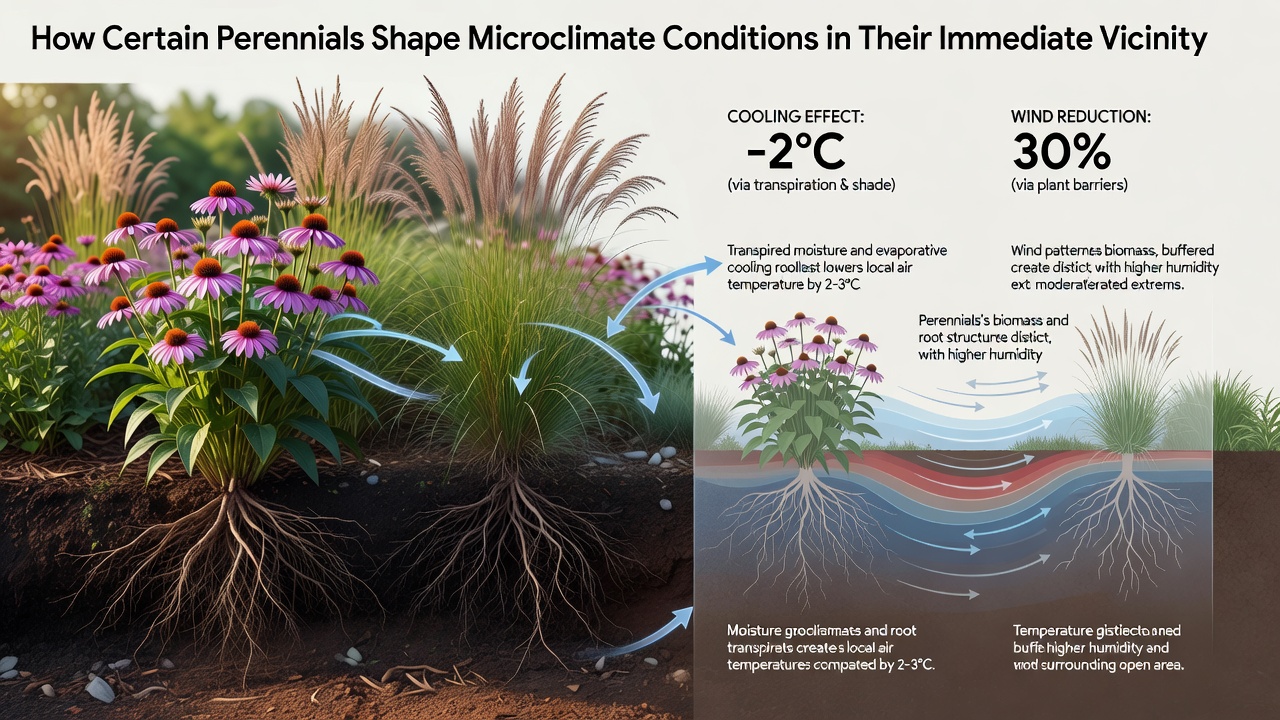
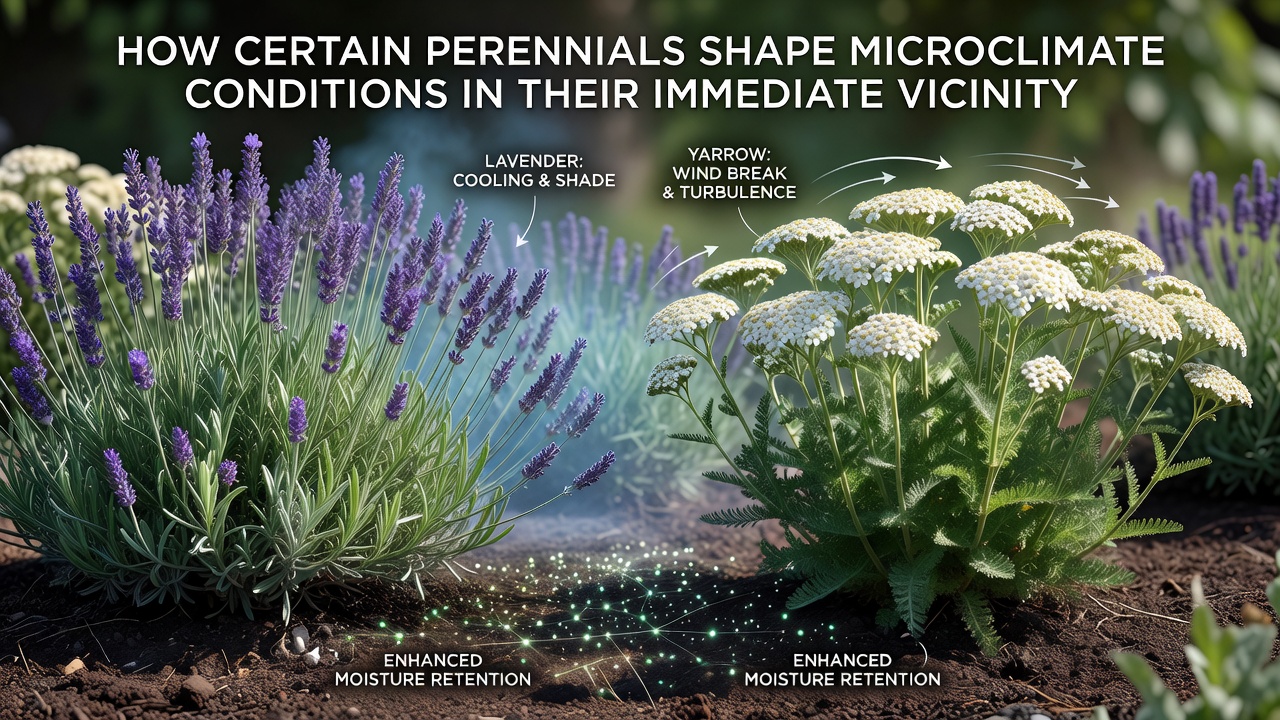
Perennials modify the air and soil conditions right around them through physical structures and biological processes that persist across seasons. Tall grasses and shrubs intercept sunlight before it reaches the ground, which lowers surface temperatures during daylight hours while allowing heat to radiate more slowly at night. Data collected across multiple field sites show temperature reductions of 2 to 5 degrees Celsius within the canopy zone compared with adjacent open ground, according to measurements compiled by the U.S. Forest Service.
Transpiration adds moisture to the air column above the plants. Roots draw water from deeper soil layers and release it through leaves, raising relative humidity by several percentage points within a meter or two of the foliage. This effect becomes most noticeable on warm afternoons when evapotranspiration rates peak and the added vapor helps buffer rapid drops in moisture that would otherwise occur in bare soil.
Temperature Regulation Through Canopy Structure
Leaf arrangement and height determine how much solar radiation reaches the ground beneath perennials. Dense evergreen species maintain consistent shading year-round, whereas deciduous types allow more light through in winter. Researchers tracking microclimate stations placed at ground level and at one-meter height recorded that clusters of perennials kept minimum nighttime temperatures 1 to 3 degrees higher than exposed sites because the canopy trapped long-wave radiation. These patterns hold across both temperate and Mediterranean climate zones where data loggers have operated continuously for multiple growing seasons.
Humidity and Vapor Pressure Gradients
Moisture released by perennial leaves creates localized humidity pockets that influence evaporation rates from nearby soil and water surfaces. In one multi-year monitoring project, stations positioned inside stands of tall perennials measured vapor pressure deficits 15 to 20 percent lower than those recorded 10 meters away in open grassland. The reduced deficit slows water loss from both the plants themselves and the surrounding ground, which in turn supports higher soil moisture retention during dry intervals. Observations from these same sites indicate the humidity effect extends roughly two to three times the average plant height outward from the stand edge before blending with ambient conditions.
Wind Modification and Boundary Layer Effects
Perennial stems and leaves act as porous barriers that slow horizontal airflow. When wind encounters a row or clump of taller perennials, velocity drops sharply on the leeward side, creating a sheltered zone where turbulent mixing decreases. Measurements taken at agricultural research stations show wind speed reductions of 40 to 60 percent within five to eight meters downwind of established perennial hedges. Lower wind speeds reduce convective heat loss from the ground and from shorter vegetation nearby, which contributes to warmer minimum temperatures during cool nights. The same sheltering also limits rapid drying of surface soil after rainfall events.
Soil Moisture and Thermal Properties
Root systems of perennials improve soil structure over time through organic matter deposition and physical penetration. Improved aggregation increases water-holding capacity, so soil within the root zone retains moisture longer than compacted or sparsely vegetated areas. Thermal conductivity changes as well; wetter soils under perennial cover absorb and release heat more gradually, flattening daily temperature swings at the surface. Long-term soil sensor networks operated by European research consortia have documented these patterns across different soil types and perennial species mixes.
Seasonal Patterns and Extended Monitoring
Effects shift with plant phenology and weather cycles. During active growth periods, transpiration and shading dominate, while dormancy reduces these influences. Continuous data collection through late 2025 and into November 2026 at several long-term ecological research sites continues to refine understanding of how perennial cover interacts with shifting precipitation patterns and temperature extremes. Preliminary outputs from these programs show that the magnitude of microclimate modification scales with stand density and species composition rather than with any single plant trait.
Conclusion
Perennials alter immediate surroundings by intercepting radiation, releasing water vapor, and obstructing airflow, which collectively produces measurable differences in temperature, humidity, and soil conditions within a few meters of the plants. Field measurements and sensor networks document these changes consistently across regions and growing seasons, providing quantitative evidence of localized microclimate effects that persist as long as the vegetation remains in place.